Search This Blog

Showing posts with label co2. Show all posts

Tuesday, August 18, 2020

In SIX Years, NDA Managed to Increase Electricity Generation from Renewables only by 3.5+ %

I have been reading about solar power in India again – last I read in-depth was I think in 2017. I found then that the rosy headlines were far from the reality of many stumbling blocks on the way of serious renewable power adoption in India.

In today’s reading also, I found a great distance between the reality and headlines. What matters is NOT installed capacity (large portions of which may never be used and which become net contributors to climate change because of the CO2 generated in constructing them), but the electricity generation mix.

After all the sound and fury of the last six years, in 2019-‘20, India generated nearly 10 % of its electricity using wind-power, solar, biomass and mini-hydro.

In SIX years of constant soundbites, the improvement in electricity generation mix in favour of renewables was only a little over 3.5 % - in 2014 it was 6.38 % of the total electricity generated, and in 2020 it was 9.99 %.

The UPA government had achieved similar improvements in electricity generated from renewables in the 5 years before demitting power to NDA : from 3.76 % of the electricity generation from renewables to 6.38 % - that is a little over 2.61 %.

In fact, in the 5 years after taking power, NDA had a similar performance : It improved the electricity generation in favour of renewables from 6.38 % to 9.24 % : nearly 2.86 %.

So the NDA government at best takes the work of the UPA government forward in its logical trajectory. It makes a whole lot of noise to show astronomical achievements which are never there on the ground when I check. Besides, it does enormous damage in other areas of life in India.

Friday, November 29, 2019

Sequestering Carbon in Soils

There is increasing emphasis on identifying strategies that will reduce the rate of enrichment of atmospheric CO2 by offsetting emissions caused by humans.

Major human caused sources of increasing CO2 equivalent emissions include the combustion of fossil fuel, cement manufacturing, deforestation and the burning of biomass, and land-use conversion including drainage of peatlands, soil tillage, animal husbandry.

We need to reduce CO2 , Methane  and Nitrous Oxide emissions and offset emissions through sequestration of carbon in soils and other terrestrial and inland aquatic ecosystems.

Land-use change, deforestation and soil cultivation have added CO2 equal to nearly 50 % of that caused by fossil fuel burning. Current rates of these activities are equal to 20 % of the emissions caused by fossil fuel burning. 

The Earth's natural systems, other than oceans and atmosphere, absorb over a third of the greenhouse gas emissions caused by humans every year. However the nearly two-thirds of the emitted carbon is added to the atmosphere and oceans every year and is fast pushing earth into a hot house state. 

Monday, April 22, 2019

A draft post of Nov 2018 is still valid.. on the Ujwala scheme

Many studies have shown that sustainable use of bio-mass for domestic energy purposes (cooking, heating and light) is a very important part of finding energy solutions for our country's rural inhabitants, most of whom use biomass today but over earthern chulhas. Many urban poor use bio-mass as well. So such chulhas (apart from biogas generators) can play a big role in improving the health of the rural poor, vastly improving efficiency in use of the bio-mass (so much less is needed for the same cooking needs) and reduce the soot effect on monsoons and melting of glaciers.

These chulhas emit much less CO2 by increasing the efficiency of the burning of the biomass, thus helping with mitigating global warming. The BJP Govt. has distributed 4 million LPG cylinders and regulators at a cost of Rs. 1600 each but there are as many suspended connections in the country (LPG customers who do not order refill even once in 90 days), indicating that a majority of those who got these free connections are too poor to pay for refills. In contrast, only about 35000 improved chulhas have been distributed in the last 4 years !

LPG was always part of the rural energy solution, never the full solution, but the Govt. was not really focused on helping the rural poor in this context. It ignored a large study that the Govt. itself funded that had warned that the rural population by and large did not exhibit affordability for LPG refills, and that the oil companies did not have a robust distribution system in rural areas.

Right from the beginning the purpose of the scheme seemed to be free publicity for Modi at the expense of the oil companies who were forced to give the cook stoves and LPG filling also on interest free loans as the beneficiaries were too poor to pay for them.

A recent tender for billboards at petrol pumps and in front of airports (!) in just three states of india has been put out by indian oil for nearly 300 crores. Might not the expense on the publicity of modi having done good to the rural women in all states of india, then reach even a 1000 crores ?! In any case, in what way does advertising on petrol pumps and in front of airports help the rural poor access the LPG scheme ??! In contrast to the hundreds of crores spent on the personal publicity of one politician, the total cost of this programme all over the country is Rs. 8000 crores in all !

Wednesday, January 02, 2019

We are making the fish in our oceans handicapped...

Fish are losing their sense of smell as rising carbon emissions turn the water they live in, to acid.
A study in 2018 July has revealed that as levels of carbonic acid in seawater rise, sea bass lose up to half their smelling capacity. Surges in atmospheric carbon dioxide increase ocean acidity as the gas dissolves in water. 
The findings are significant as these fish rely on smell to do everything from finding food and potential mates to detecting predators in their vicinity.
The scientists compared the behaviour of young sea bass at current carbon dioxide levels to the levels expected at the end of the century, when oceans are predicted to contain up to two and a half times the levels of the gas seen today.They noticed big changes in the behaviour of the fish inhabiting the most acidic water. Not only did the bass swim less, they appeared not to notice the presence of predators.
Previous research has indicated that besides directly affecting fish noses, carbon dioxide harms fish nervous systems and disrupts the processing of information in their brains.
Having to cope with two different problems caused by carbon dioxide, rather than just one, may reduce the ability of fish to adapt.
Other studies have suggested that as seawater becomes more acidic, it will erode the hearing ability of fish and make them unable to hear approaching predators.

Tuesday, December 25, 2018

A closer look at emissions of gasses that warm the atmosphere..

India's per capita Carbon-di-Oxide (CO2) emissions climbed from 1 ton in 2005 to 2 tonnes in 2016.

The per capita CO2 emissions of the richest 10 per cent Indians are about 4.4 tonnes.

The average monthly household income of the top 1% Indians could be as high as Rs. 1.17 lakh while that of the top 10 % could be Rs. 62,574.

It seems logical to me to assume that the CO2 emissions of the top 1 % of Indians then could be double that of the top 10 % of Indians, and thus at 9 tonnes per capita.


The EU per capita CO2 emissions in comparison are 7 tonnes a year. 

In 2016, China, US, EU28, India, Russia and Japan were the world’s largest emitters in decreasing order of CO2 emissions. They showed different trends though, with 2% decreases for US and Russia, a 1% decrease for Japan, constant emissions for China and EU28 and a 5% increase for India. India does not show yet any decoupling of their emissions growth from their economic growth, unlike Brazil, where emissions fell by 6%.

In 2016, nearly 40 % of CO2 emissions worldwide were due to the power industry. 22 % CO2 emissions were on account of other industrial combustion (such as by use of fuels for industry). 22 % emissions were on account of transport. 8 percent emissions were for buildings (such as for heating) and another 8 % for non-combustion use (such as for plastic products and fertilizers). 

Another, 2014 assessment of global emissions from greenhouse gases (GHGs - all of which contribute to global warming and which consist of methane and nitrous oxide, besides CO2), found that 25 % of GHGs were emitted for electricity and heat production, 24 % by agriculture and forestry, 21 % by industry, 14 % for transportation, 10 % for fuel extraction and refining, and 6 % for heat and cooking in buildings. 

Wednesday, November 28, 2018

Methane..

Methane accounts for 20% of the total radiative forcing from all of the long-lived and globally mixed greenhouse gases.

Methane is a potent greenhouse gas. Carbon dioxide is the main one, because the atmosphere holds 200 times as much of it. But a given amount of methane traps at least 25 times as much heat—unless you burn it first. Then it enters the atmosphere as CO₂.


A lot of methane is being burned these days. In the past decade the technology called hydraulic fracturing, “fracking” for short, has enabled drillers in the United States to extract natural gas from deeply buried shales they couldn’t tap before. Natural gas supplies have surged; prices have plummeted. Fracking is now spreading around the world, and it’s controversial. The gas boom has degraded landscapes and polluted water. But it has also had environmental benefits. Natural gas burns much cleaner than coal. In part because American power plants have been switching from coal to cheap gas, U.S. emissions of CO₂ from fossil fuels fell last year, even as the world set another record.


Wednesday, October 24, 2018

There is no comparison even...

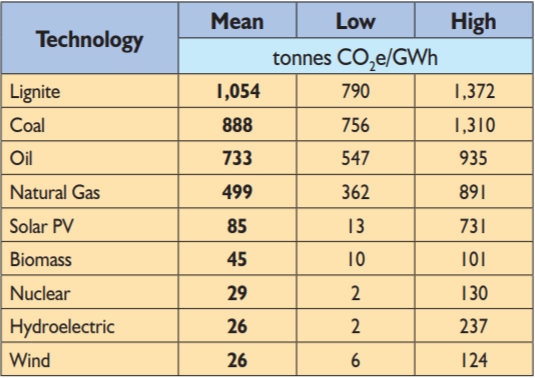
Someone had asked me about the lifecycle emissions of solar power compared to power generated from fossil fuels..

This study summarized 21 previous studies from reputed sources, nearly all done in the first decade of this century..

These are its astonishing conclusions :


There is no comparison even between fossil fuels and non-fossil-fuel sources of  Co2 emissions per gigawatt hour.