Search This Blog

Showing posts with label humidity. Show all posts

Saturday, August 22, 2020

Explaining 'Wet-Bulb' Temperatures

What Are 'Wet-Bulb' Temperatures

Wet bulb temperature is a combination of temperature and humidity. There are limits to what wet bulb temperature the human body can survive beyond a few hours, absent airconditioning.

The 1st chart has temperatures on top in C. and Humidity on Left. The intersection of both shows the applicable wet-bulb temperature. 

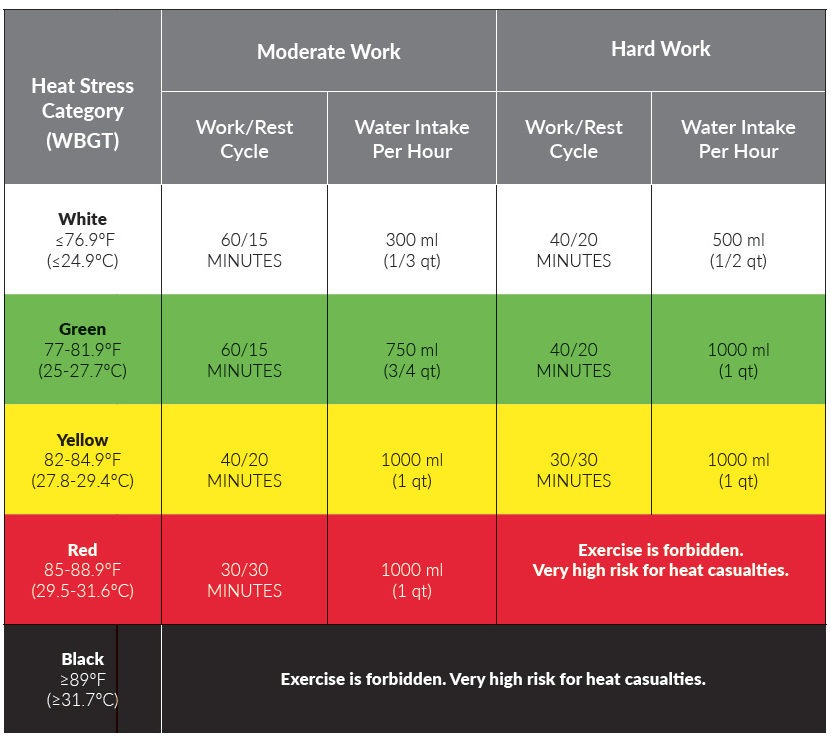
The second chart shows how to interpret the colours of the wet-bulb temperature squares in the first chart. Concern really begins at Red and then Black squares. 

When the wet-bulb temp is in Red, one should not work for more than 30 min at a time (followed by rest for 30 min), and one should be having one litre of water for every such work hour. Even these guidelines are for fit hikers, and the rest of us ordinary folks should work even less I suppose. 

When the wet-bulb square is black, one is not suppose to work at all outside of airconditioning.

What Did This Imply in say Delhi, in June, 2018 ?

What does this imply for Delhi wet-bulb temperatures, say in June ? The science says, no work should be done in day light hours, at all outside of airconditioning in June ! Here are four sample June days where i studied the hourly temperatures :

# On June 1st, 2018, for example, one could have done restricted work from midnight-7.30 AM, and 8 PM to midnight ! but no work in day time as it would fall into black wet-bulb squares.

# On 8th Jun, one could have done unrestricted worked midnight to 6 AM.  No work till midnight after that !

# On 15th June, no work outside of airconditioning over 24 hours !

# On 22nd June, only midnight to 6 AM was within safe wet bulb temperature. All the rest of the hours were in black, that is no one was supposed to do any work outside of airconditioning !

Health Impacts of Great Heat and Humidity

A healthy internal body temperature falls within a narrow window. The average person has a baseline temperature between 98°F (37°C) and 100°F (37.8°C). If your body temperature rises as high as 107.6°F (42 °C), you can suffer brain damage or even death. 

Just 5 degrees C deviation of temperature from the usual can have severe health consequences in the human body. 

If your body needs to cool down, these mechanisms include:

 #   Sweating: Your sweat glands release sweat, which cools your skin as it evaporates. This helps lower your internal temperature.
 #   Vasodilatation: The blood vessels under your skin get wider. This increases blood flow to your skin where it is cooler — away from your warm inner body. This lets your body release heat through heat radiation.

This makes the heart beat faster and pump harder. On a hot day, it may circulate two to four times as much blood each minute as it does on a cool day.

Sweat pulls more than heat from the body—it also pulls out sodium, potassium, and other minerals needed for muscle contractions, nerve transmissions, and water balance. Most healthy people tolerate these changes without missing a beat. People with damaged or weakened hearts, have a much harder time, and may succumb to heat stroke.

What do Wet-Bulb Temperatures do to Humans ?


Distance runners were asked to run at speed for 60 min at 31 C temperature at 5 levels of humidity : 23, 43, 52, 61 and 71% (on separate days for each varying level of humidity I presume). 

Immediately thereafter, participants continued running at the same velocity while the treadmill gradient was elevated by 2% every 2 min until volitional exhaustion.

The ability to regulate body temperature during running exercise at 31°C ambient temperature was progressively compromised as humidity increased, and became substantially so when humidity exceeded 60%.

There was a non-linear increase in core temperature and skin temperature during the exercise taken when humidity was at 61 % and at 71 %.

Evaporation of sweat from the skin halved as humidity levels increased from 23 to 71 %.

The study showed that evaporative heat loss plays a vital role as the main avenue for heat dissipation during exercise in the a heat-stress environment.

Heat Stress Imposes a Robust Upper Limit to Adaptation by Humans

A pioneering study published in 2010 had shown that heat stress imposes a robust upper limit to adaptation by humans to gloabl warming.

Peak heat stress, quantified by the wet-bulb temperature TW, is surprisingly similar across diverse climates today (the reference is to 2010). TW never exceeds 31 °C. Any exceedence of 35 °C for extended periods should induce hyperthermia in humans and other mammals, as dissipation of metabolic heat becomes impossible. While this never happens now, it would begin to occur with higher levels of global warming.

Humans maintain a core body temperature near 37 °C that varies slightly among individuals but does not adapt to local climate. Human skin temperature is strongly regulated at 35 °C or below under normal conditions, because the skin must be cooler than body core in order for metabolic heat to be conducted to the skin.

Sustained skin temperatures above 35 °C imply elevated core body temperatures (hyperthermia), which reach lethal values (42–43 °C) for skin temperatures of 37–38 °C even for acclimated and fit individuals.

Saturday, January 12, 2019

Everything you wanted to know about Room Heaters..

Everything you wanted to know about Room Heaters : Blowers, Halogen Heater and Oil Radiators :
  • Fan heaters use up oxygen and humidity. They are also the most power hungry. 
  • Infrared heaters – which is what halogen heaters are, are the most power efficient, and have no impact on oxygen or humidity. Their heat is absorbed by objects in their line of sight – the human body, carpets and bedding etc. 
  • Oil heaters cost more to run, are slow to heat up, and waste heat by continuing to warm a space after they are switched off as oil takes time to cool down. The heat generated by oil heaters is prone to rising up towards the ceiling further causing heat wastage. 
  • Ofcourse oil heaters are the solution for people who find the light from infrared heaters annoying. 
  • Only fan heaters would affect asthmatics as they distribute the air around the room, not infrared or oil heaters. 

+++++++++++++++
Oil-filled heaters are more commonly known as radiators. Although they are filled with oil, they are still powered by electricity. Electric current heats up the oil inside the heater to emit warmth through radiant heating.

A halogen heater is basically a type of infrared heater, but smaller in size compared to other infrared heaters. An infrared heater emits heat in the form of electromagnetic radiation. Halogens are a combination of nonmetallic elements which can heat up hotter than other heat conductors, on a lower level of energy. Halogen heaters heat faster, which further reduces energy consumption. This is because Halogen elements require a lesser amount of energy compared to other heat conductors like electric coils.

Rather than heating the air, as with convection from a fan heater, in radiant heating the infrared waves are absorbed by solid elements in the room, like your skin, pajamas, and bedding. These types of heaters offer an added benefit for those with sensitive skin. Convection heaters heat up the air in a room, drying out both the air and the skin of everyone in it.

Infrared heaters radiate infra-red light which strikes objects and heats them directly, heating the intervening air less. Oil filled radiators, work by heating the air in the room by natural convection.

In a study in Malta, infrared heating panels were found to heat a room faster than an oil-filled electric resistance convection heater. The study also found that walls retain heat with infrared heating, which allows them to remain dry, ensuring that mould has a 0% chance of spreading.

If you are heating a space which has ventilation, then a fan heater or radiator would be less useful than an infrared heater. Much of the heat you generate via convection will escape with the air in and out of the room.

++++++++++++++++++++

This net page speaks of the many health benefits of infrared heating :

Unlike convection heating, Infrared heating has clear health benefits for the human body. While convectional heaters produce the heat that warms up the air and surfaces, Infrared heaters heat objects and people directly. It creates a movement of heat in the body through optimum blood circulation and this way produces a sense of deep warmth.

Furthermore, Infrared heating is beneficial for people with health conditions such as asthma or bronchial ailments. Its unique heating method does not create air currents that increase dust circulation in the room. It also prevents unwanted humidity that causes mould to grow.

Fresh air is also essential for a healthy living environment. However ventilation comes at a price of creating heat loss, especially if it is combined with convectional heating system. Opposite to traditional heaters, Infrared heating products heat the objects and people, while convectional heating works on much higher temperatures and relies on hot air movement. It means that heat loss becomes greater, as hot air travels out through the vents and opened windows. Meanwhile, Infrared heating does not create air currents and in this way significantly reduces heat loss.


++++++++++++++++++

The experience of this netizen with infrared heaters is useful for situations when you need instant warmth like in a bathroom during very cold months. He also points to the great economy in using such heaters, and the fact that they can last decades :

From personal experience, I always feel warmer in front of a radiative heater, and they certainly produce less noise pollution than fan heaters, so are more pleasant to be around. Both are more controllable than oil filled radiators, so you get heat out of them sooner after you need it and waste little heat when you no longer need it.

I find infra-red heaters particularly useful in bathrooms. Heaters like the following are (or were) common in UK bathrooms:


The way to use a heater like this is on demand.

I turn on my bathroom infrared wall heater before I get in the shower so it is up to full heat by the time I get out of the shower. The infra-red heat keeps me nice and warm in those crucial moments between stopping the hot water flow and towelling-off the rapidly cooling water. I then turn off the heater as I leave the bathroom, having wasted little electricity unnecessarily heating it.

I have never understood why people replace infrared wall heaters in bathrooms with fan heaters. I find that they can never warm up the air in the bathroom enough during the time you are showering so that you don't feel cold during towelling. I know that infrared heaters are seen as old technology, but they work very well, are as 'efficient' as every other electric heater and are far more reliable than fan heaters. I have never had a fan heater last for more than a decade, but the infrared heater in my bathroom has been working for over four.


+++++++++++++++++++

Keeping the heater on all night is not good for the quality of your sleep. For restful sleep, our bodies actually require the temperature to be cooler. A decrease in temperature at night signals to our brain that it’s time to sleep, while our brain perceives heat as a time for energy and alertness (like when your body heats up from exercise).

Turn your heater on before bed, and it can warm your room up enough for you to fall asleep comfortably. As the hot air dissipates, the resulting coolness will help your body stay asleep.

Tuesday, October 30, 2018

Without action, climate change could devastate South Asia..

In South Asia, research of 2017 at MIT suggests that by the end of this century climate change could lead to summer heat waves with levels of heat and humidity that exceed what humans can survive without protection.

The study shows these deadly heat waves could begin within as little as a few decades to strike regions of India, Pakistan, and Bangladesh, including the fertile Indus and Ganges river basins that produce much of the region’s food supply.

The study follows an earlier report by Eltahir and his team that looked at projected heat waves in the Persian Gulf region. While the number of extreme-heat days projected for that region was even worse than for South Asia, Eltahir says the impact in the latter area could be vastly more severe. That’s because while the Persian Gulf area has a relatively small, relatively wealthy population and little agricultural land, the areas likely to be hardest hit in northern India, Bangladesh, and southern Pakistan are home to 1.5 billion people. These areas are also among the poorest in the region, with much of the population dependent on subsistence farming that requires long hours of hard labor out in the open and unprotected from the sun.

While the projections show the Persian Gulf may become the region of the worst heat waves on the planet, northern India is a close second, Eltahir says, and eastern China, also densely populated, i
s third. The highest concentrations of heat in the Persian Gulf region would be seen over water and not land, unlike in the Indo-Gangetic plains where the brunt will be borne on inhabited land.

The new analysis is based on recent research showing that hot weather’s most deadly effects for humans comes from a combination of high temperature and high humidity, an index which is measured by a reading known as wet-bulb temperature.
The internal temperature of the human body is maintained at 37 degrees Celsius, while the temperature on the surface is around 35 °C. Sweating is the key process to this constant temperature modulation and the ability for moisture to evaporate is affected by heat and humidity. At a wet-bulb temperature of 35 degrees Celsius, the human body cannot cool itself enough to survive more than a few hours.

A previous study of temperature and humidity records show that in today’s climate, wet-bulb temperatures have rarely exceeded about 31 C anywhere on Earth. While the earlier report from Eltahir and his colleagues showed that this survivability limit would start to be exceeded occasionally in the Persian Gulf region by the end of this century, actual readings there in the summer of 2015 showed that the 35-degree wet-bulb limit had almost been reached already, suggesting that such extremes could begin happening earlier than projected. The summer of 2015 also produced one of the deadliest heat waves in history in South Asia, killing an estimated 3,500 people in Pakistan and India.

The study shows that by century’s end, absent serious reductions in global emissions, the most extreme, heat waves would increase from wet-bulb temperatures of about 31 C to 34.2 C. “It brings us close to the threshold” of survivability, he says, and “anything in the 30s is very severe.”

In today’s climate, about 2 percent of the Indian population sometimes gets exposed to extremes of 32-degree wet-bulb temperatures. According to this study, by 2100 that will increase to about 70 percent of the population, and about 2 percent of the people will sometimes be exposed to the survivability limit of 35 degrees. And because the region is important agriculturally, it’s not just those directly affected by the heat who will suffer, Eltahir says: “With the disruption to the agricultural production, it doesn’t need to be the heat wave itself that kills people. Production will go down, so potentially everyone will suffer.”


Heat waves over the last decade have been seen to cause more mortality among urban rather than rural Indians. One of the reasons for this is the work routine of Indian farmers which keeps them indoors during the hottest hours of the day. In cities, on the other hand, heavy concentration of concrete and glass along with limited natural cover increases temperature, creating the heat-island effect. Studies have found that by 2100, cities could get up to as much as 8°C hotter than current levels! This, combined with the typically round-the-clock physical labour in cities, has caused heavily disproportionate mortality in cities rather than in the country side.

Studies looking at heat waves in Ahmedabad found that spikes in mortality correlate with spikes in temperature. The case has been made that the actual number could be much higher since the National Crime Record Bureau only records death by heat strokes as a heat wave-associated death. This could also be the reason for the huge discrepancy in the number of deaths associated with the disastrous 2003 heat wave that struck Europe and killed over 70,000 and the 2015 Indian heat wave in which 2,241 people died. Both the events were of comparable duration and intensity.


The decadal mean of daily maximum temperature for April and May in the 2010s is 40 to 42 degrees over large parts of India. In the 1950s, the area with this high temperature was limited to only a small spot in south-central India touching 41 degrees. The region with temperature over 40 degrees began to expand in the 1970s and 1980s. The region with temperatures exceeding 41 degrees has expanded, and a region with temperatures greater than 42 degrees has appeared in south-central India in the 2010s, the study has found.

But while the study provides a grim warning about what could happen, it is far from inevitable, Eltahir stresses. The study examined not just the “business as usual” case but also the effects under a moderate mitigation scenario, which showed that these dramatic, deadly effects can still be averted.

Acknowledgement : sourced entirely from this article.