Search This Blog

Showing posts with label south asia. Show all posts

Wednesday, September 06, 2023

The Clay Mine and Other Matters

A friend, Hamza shared a searing well-known poem : ‘Mitti Ki Khan’ by Afzal Ahmed Syed. Hamza reads it here for us. 


It describes the fate of those tied to work in slavery like conditions. 

Some 40 million people or one in every 200 people are languishing in slavery across the globe, according to the International Labor Organization. This might well be a conservative figure as many forms of slavery are invisible and largely unreported. Yet the figure is more than three times higher than the roughly 13 million people captured and sold as slaves between the 16th and 19th centuries in the transatlantic slave trade.

About 70 percent of slaves are women and girls, while children account for 25 percent or 10 million slaves worldwide.

Slavery is a highly lucrative business in the modern world that generates as much as US$150 billion in profits every year.

Slavery is a condition or practice that people accept against their will, ranging from forced labor, debt bondage, forced marriage and human trafficking to the commercial sex industry.

China, the Democratic Republic of Congo, India, Indonesia, Iran, Nigeria, North Korea, Pakistan, the Philippines and Russia account for 60 percent of modern-day slaves.

Endemic poverty, unsafe migration, weak governance and abuses of cultural practices, are all blamed for fuelling slavery in Asian nations. But a major driving force is a lack of anti-slavery legislation in many countries, which means one cannot be prosecuted and punished in a criminal court for putting another human being into slavery.

Some 94 out 193 member states have not passed laws prohibiting slavery.  Most of these countries are in Asia. Most Asian nations have anti-trafficking and labor laws but such legislation does not necessarily address slavery.

Asia is both a source and a destination of human trafficking, one of the many forms of slavery.

Global supply chains for agriculture, construction, fishing, clothing, fashion, beauty and the sex industry are feeding grounds for trafficking. The global sex industry has some 4.5 million women and girls trapped in perpetual slavery and about two-thirds of them are in the Asia-Pacific.

Every year, tens of thousands of poor young girls and women from relatively impoverished regions like South Asia are trafficked and sold into the sex industry in well-off countries in Southeast Asia, East Asia, the Middle East and even Europe.

India is home to the largest numbers of slaves, ranging from 14 to 18 million with women and girls making up the majority. It is a major source country for sex trafficking to Southeast and East Asia and a prime destination of sex trafficking from other South Asian countries. According to a 2017 study, India has around 16 million sex workers and about 37 percent are minors.

A common and cruel form of modern-day slavery in South Asia is debt bondage. Under this unlawful and humiliating system, men, women, children and even entire families are enslaved by the debt holder to repay debts through endless labor. The debt holder often squeezes laborers with psychological pressure and physical violence, denies freedom of movement and offers a lump-sum amount that is never enough for survival. A bonded worker remains enslaved until death.


Debt bondage is still prevalent in agriculture, brick kilns, construction sites, rice mills, embroidery and garment factories, stone quarries and even private houses. Pakistan has an estimated 2.1 million bonded laborers out of 3.1 million people living in slavery. The bonded labor system still exists in agriculture, brick making, carpet weaving, mining, fishing, domestic work and handicraft production, where a significant number of laborers are children.

The above referenced poem entitled 'Clay Mine' allegorically refers to their situation.

There is a shocking article on the plight of workers in the tea industry in Bangladesh. From what I could gather, several large tea estates are still owned by the British. 

The Clay Mine poem was written in the context of those selling everything they had to be able to migrate to the middle east to make a decent living. But many low-level workers suffer terribly in unjust systems in the middle east to this day. 

Sadly, it appears that some Western democracies are making up their labour shortages via the same very exploitative systems. 

Tuesday, January 15, 2019

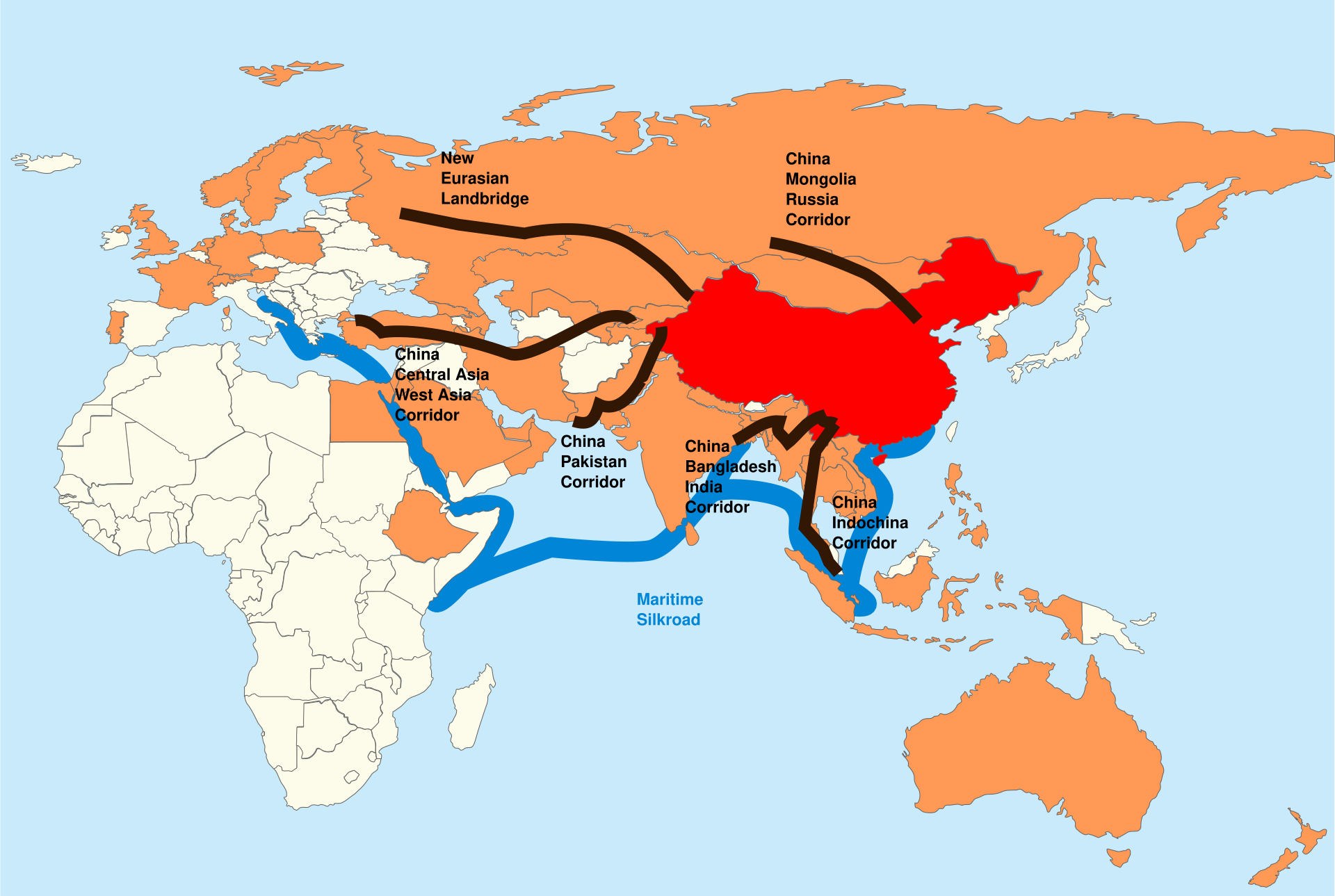
China's One Belt One Road is changing Asia

“One Belt” refers to the Silk Road Economic Belt where China plans to invest heavily in infrastructure to underpin its long-term presence in Eurasia. “One Road”, meanwhile, is the 21st century maritime Silk Road which will call for the construction of ports and maritime facilities from the Pacific Ocean to the Baltic Sea. 

Map of Asia, showing the OBOR initiative
  China  Members of the Asian Infrastructure Investment Bank  The six Belt and Road corridors  Maritime silk road. Image from here.

The initiative serves two key economic objectives for China. First, it creates demand overseas for China’s excess capacity in areas such as steel, cement and aluminium. The number of cross-border co-operation projects envisaged by the Silk Road plan already exceed 900 projects and involve 64 different countries. The total investment value of these projects — most of which are concentrated in the infrastructure sector — is estimated at $890bn.

In 2014, China’s outward direct investment exceeded the foreign direct investment it attracted for the first time. 

Beyond South Asia, the other economic corridors which are part of the huge One Belt, One Road plan will have important repercussions for economic growth and infrastructure investment in countries ranging from Mongolia and Russia to the five Central Asian republics of Kazakhstan, Kyrgyzstan, Tajikistan, Uzbekistan and Turkmenistan, as well as in the Middle East and parts of Europe. 

The Silk Road project could kick-start a virtuous circle for infrastructure finance across the region by strengthening credit ratings, supporting the evolution of local capital markets and making projects more bankable. 

“You only need to visit China and use the high-speed rail system to see that it is starting to lead the world in terms of infrastructure development,” says HSBC’s Dickens. “China is now focused on starting to export some of that technological and construction experience. Be it in high speed rail, nuclear or renewables, China has a lot of knowledge as well as capital to put to work across the world.”

Monday, December 24, 2018

Climate Change and the Poor..

Energy use alone is responsible for nearly three quarters of global greenhouse emissions, and most energy is consumed by the rich: to drive their cars, heat their buildings and manufacture goods such as refrigerators, air conditioners and televisions – all of which then demand more energy throughout their lifetime. Globally, the wealthiest 10% of people may be responsible for more than 50% of emissions.

Though high-income households bear more responsibility for climate change, its most severe impacts will be felt by the poor, who are more likely to live in areas exposed to environmental hazards, such as floodplains or steep slopes, and whose homes may also lack basic infrastructure that might reduce the impacts of extreme weather, such as drains to safely carry away storm-water.

In the aftermath of natural disasters, it is the poorest in society who struggle to access the financial resources they need to rebuild their homes and lives, thus turning a storm into a catastrophe.

Having reviewed more than 700 studies on transport, buildings and waste management, a research team found that choosing low-carbon options would not only improve public health, create jobs, enhance productivity and cut energy bills, but that many of the gains would be mostly enjoyed by low-income urban residents. Those most vulnerable to climate change are therefore also those who would benefit most from climate action.

A report shows that climate change is an acute threat to poorer people across the world, with the power to push more than 100 million people back into poverty over the next fifteen years. And the poorest regions of the world – Sub-Saharan Africa and South Asia – will be hit the hardest. 
In India alone, an additional 45 million people could be pushed back over the poverty line by 2030, primarily due to agricultural shocks and increased incidence of disease.

Even in the US, climate change will hit low-income communities the hardest even as it takes a toll on the U.S. in general.

We have the ability to end extreme poverty even in the face of climate change, but to succeed, climate considerations will need to be integrated into development work. And we will need to act fast, because as climate impacts increase, so will the difficulty and cost of eradicating poverty.

The report demonstrates that ending poverty and fighting climate change cannot be done in isolation – the two will be much more easily achieved if they are addressed together,

In the longer term, only immediate and continued efforts to reduce global emissions will save poor people from climate impacts, according to the report. To be successful, governments should design mitigation policies so that they protect, and even benefit, poor people. And action can be taken to reduce the burden of policies that would impose new costs – such as by strengthening social protection and assistance, or using cash transfers

One analysis of 20 developing countries showed that collecting and redistributing energy taxes would benefit poor people despite higher energy prices, with the bottom 20 percent of the population experiencing a net $13 gain for each $100 of additional tax. Well-designed emissions-reductions programs that strengthen the productivity of agriculture and protect ecosystems could benefit 20-50 million low-income households by 2030 through payments for ecosystem services.

Tuesday, October 30, 2018

Without action, climate change could devastate South Asia..

In South Asia, research of 2017 at MIT suggests that by the end of this century climate change could lead to summer heat waves with levels of heat and humidity that exceed what humans can survive without protection.

The study shows these deadly heat waves could begin within as little as a few decades to strike regions of India, Pakistan, and Bangladesh, including the fertile Indus and Ganges river basins that produce much of the region’s food supply.

The study follows an earlier report by Eltahir and his team that looked at projected heat waves in the Persian Gulf region. While the number of extreme-heat days projected for that region was even worse than for South Asia, Eltahir says the impact in the latter area could be vastly more severe. That’s because while the Persian Gulf area has a relatively small, relatively wealthy population and little agricultural land, the areas likely to be hardest hit in northern India, Bangladesh, and southern Pakistan are home to 1.5 billion people. These areas are also among the poorest in the region, with much of the population dependent on subsistence farming that requires long hours of hard labor out in the open and unprotected from the sun.

While the projections show the Persian Gulf may become the region of the worst heat waves on the planet, northern India is a close second, Eltahir says, and eastern China, also densely populated, i
s third. The highest concentrations of heat in the Persian Gulf region would be seen over water and not land, unlike in the Indo-Gangetic plains where the brunt will be borne on inhabited land.

The new analysis is based on recent research showing that hot weather’s most deadly effects for humans comes from a combination of high temperature and high humidity, an index which is measured by a reading known as wet-bulb temperature.
The internal temperature of the human body is maintained at 37 degrees Celsius, while the temperature on the surface is around 35 °C. Sweating is the key process to this constant temperature modulation and the ability for moisture to evaporate is affected by heat and humidity. At a wet-bulb temperature of 35 degrees Celsius, the human body cannot cool itself enough to survive more than a few hours.

A previous study of temperature and humidity records show that in today’s climate, wet-bulb temperatures have rarely exceeded about 31 C anywhere on Earth. While the earlier report from Eltahir and his colleagues showed that this survivability limit would start to be exceeded occasionally in the Persian Gulf region by the end of this century, actual readings there in the summer of 2015 showed that the 35-degree wet-bulb limit had almost been reached already, suggesting that such extremes could begin happening earlier than projected. The summer of 2015 also produced one of the deadliest heat waves in history in South Asia, killing an estimated 3,500 people in Pakistan and India.

The study shows that by century’s end, absent serious reductions in global emissions, the most extreme, heat waves would increase from wet-bulb temperatures of about 31 C to 34.2 C. “It brings us close to the threshold” of survivability, he says, and “anything in the 30s is very severe.”

In today’s climate, about 2 percent of the Indian population sometimes gets exposed to extremes of 32-degree wet-bulb temperatures. According to this study, by 2100 that will increase to about 70 percent of the population, and about 2 percent of the people will sometimes be exposed to the survivability limit of 35 degrees. And because the region is important agriculturally, it’s not just those directly affected by the heat who will suffer, Eltahir says: “With the disruption to the agricultural production, it doesn’t need to be the heat wave itself that kills people. Production will go down, so potentially everyone will suffer.”


Heat waves over the last decade have been seen to cause more mortality among urban rather than rural Indians. One of the reasons for this is the work routine of Indian farmers which keeps them indoors during the hottest hours of the day. In cities, on the other hand, heavy concentration of concrete and glass along with limited natural cover increases temperature, creating the heat-island effect. Studies have found that by 2100, cities could get up to as much as 8°C hotter than current levels! This, combined with the typically round-the-clock physical labour in cities, has caused heavily disproportionate mortality in cities rather than in the country side.

Studies looking at heat waves in Ahmedabad found that spikes in mortality correlate with spikes in temperature. The case has been made that the actual number could be much higher since the National Crime Record Bureau only records death by heat strokes as a heat wave-associated death. This could also be the reason for the huge discrepancy in the number of deaths associated with the disastrous 2003 heat wave that struck Europe and killed over 70,000 and the 2015 Indian heat wave in which 2,241 people died. Both the events were of comparable duration and intensity.


The decadal mean of daily maximum temperature for April and May in the 2010s is 40 to 42 degrees over large parts of India. In the 1950s, the area with this high temperature was limited to only a small spot in south-central India touching 41 degrees. The region with temperature over 40 degrees began to expand in the 1970s and 1980s. The region with temperatures exceeding 41 degrees has expanded, and a region with temperatures greater than 42 degrees has appeared in south-central India in the 2010s, the study has found.

But while the study provides a grim warning about what could happen, it is far from inevitable, Eltahir stresses. The study examined not just the “business as usual” case but also the effects under a moderate mitigation scenario, which showed that these dramatic, deadly effects can still be averted.

Acknowledgement : sourced entirely from this article.

Sunday, October 28, 2018

When South Asia is warmer by 2C....

A 2 C warmer world maybe with us as soon as 2030.

In a 2 C warmer world, the high mountains of Asia will lose 36 % of their glacial mass.

Extreme rainfall events in South Asia will increase by 50%

Average temperature in Asia will have risen by 3 C.

Summer length in South Asia will increase by 55 days.

The frequency of extreme heat events in South Asia will go up 4 times.

In a 2 C warmer world, the number of heat waves in india will increase by 9 times. Their duration will increase 3 times. The population exposed to such harsh temperatures will be 15 times more.

The population affected by river flooding in India will go up by nearly six times.

India has been reporting one drought every three years in the last few decades. The length of an average drought in South Asia will go up by two months in a 2 C warmer world.


Saturday, October 13, 2018

World hunger is rising year on year..

I am distressed at reading Times of India and Hindustan Times reports on the recent UN report on climate change.. the articles do NOT communicate the urgency of the peril we are all in.

During the second half of the twentieth century, global food availability and access developed rapidly enough to keep abreast of population growth. As a result, many countries improved their food security and made impressive achievements in reducing hunger and malnutrition.

But now, World hunger is rising year on year - nearly a billion people suffered from chronic food deprivation in 2017, where a few years ago, these numbers were falling. Persistent instability in conflict-ridden regions, adverse climate events in many regions of the world and economic slowdowns that have affected more peaceful regions, all help to explain this deteriorating situation.

In 2017, one in 7 people in South Asia was undernourished - a rate equalled or surpassed only by the Caribbean and many parts of Africa.

The number of people facing crisis-level food insecurity (requiring immediate emergency action to safeguard their lives and preserve their livelihoods) continues to increase as well - from 80 million in 2015, to 124 million in 2017. Severe food insecurity is higher in 2017 than it was in 2014 in every major region, except North America and Europe.

Anaemia is also growing in the world with grave consequences for brain development and physical output of those who are anaemic. Anaemia in pregnant women affects their to-be born children also, and life-long. In the years 2006-2016, India could reduce anaemia among women of reproductive age by only 4 percentage points, from 57 to 53 %. This tells us starkly about the lack of greens and nuts in the diet of women in our country.

Climate variability and extremes are a key force behind the recent rise in global hunger. The number of extreme climate-related disasters, including extreme heat, droughts, floods and storms, has doubled since the early 1990s. These harm agricultural productivity, contributing to shortfalls in food availability, with knock-on effects causing food price hikes and income losses, that reduce people’s access to food.

2011–2016 have been characterized by a number of severe droughts in many regions. Some of these feature among the most extreme droughts historically (e.g. state of California in the United States of America; Australia), while others were unusually prolonged and spread over larger areas (e.g. Somalia, Southern Africa, India, and the Dry Corridor of Central America).

Exposure to more complex, frequent and intense climate extremes is threatening to erode and reverse gains made in ending hunger and malnutrition. The cumulative effect of changes in climate is undermining all dimensions of food security – food availability, access, utilization and stability.

Severe droughts linked to the strong El Niño of 2015–2016 affected many countries, contributing to the recent uptick in undernourishment at the global level. In that period, there were below-normal rainfall levels over a large area of the globe. Information from country food balance sheets pointed to reductions in food availability and price increases.

Changes in climate are already undermining production of major crops (wheat, rice and maize). Countries try to compensate for domestic production losses through imports, though supplies are often limited. Overall, more countries are vulnerable to the risk of food insecurity and malnutrition now, than they were in the early 1990s.

Friday, May 11, 2018

Poverty Reduction - the International Experience

Last year, an Oxford University study said that the share of people living in extreme poverty has declined continuously for two centuries; and it has never declined faster than in recent years. "This long decline is one of the greatest achievements of humanity", it said.


It went on to say that a claim that often comes up in discussions of extreme poverty is that the share of people in extreme poverty is declining only because international institutions deliberately choose a poverty line that is much too low. It is suggested then that "true poverty" in the world is actually increasing. However the study says that this allegation is unfounded. 
The USD 1.9 a day per person expenditure poverty line translates to about 700 USD a year per person. If we position the poverty line higher - at 1,000 USD per year, in 2003, 48% of the world population was below this poverty line; and ten years later, in 2013, 29% was below this line. 
If we place the international poverty line much higher at 4,000 USD, then we see that in 2003, 80% of the world population was below that poverty line. 10 years later: 67%.
We can also look back over a longer time period - of 33 years, from 1981 to 2013, which also this study reports on. Much of the globally comparable poverty data became available in 1981. In that year, a little over 30 % of the people of 'Non-Rich countries' (all countries of the world save the 24 developed ones - Western & Southern Europe, UK, US, Australia & New Zealand) earned USD 1100+. In contrast, in 2013, such people comprised nearly 70 % of non-rich countries. 
In 1981, more than half the people in non-rich countries earned just uptil USD 1.9 a day. By 2013 this percentage had dwindled to just 13 % !
A study describes how the performance of developing countries against poverty is quite diverse. Inequality comes  into the story in efforts to explain this diverse performance. Amongst growing developing countries in terms of mean household income, those experiencing falling inequality see the $1.25 a day poverty rate falling at a median rate of about 1.30% points per year versus a median fall of only 0.42 % points per year for countries with rising inequality.
For example, Botswana in Africa has experienced tremendous income increases, even by global standards, but the growth has been transformed to only a minimal decline in poverty. In contrast, Ghana, also in Africa, has succeeded in translating its relatively modest growth to considerable poverty reduction. The difference in the levels of income inequality between the two countries appears to explain much of this disparity in performance.
Bolivia’s case is even more illustrative. While the country’s mean monthly income increased slightly from 175 dollars in 1990 to over 200 dollars in 2005, its poverty rate actually rose from 4.0 percent to 20 percent over the same period. The main culprit was the considerable increase in income inequality.
Based on cross-country African data, a study found that poverty is more sensitive to income inequality than it is to the level of income. 

It is noteworthy that poverty fell less in India during 1981-1995 and in 1996-2005 than in the South Asian region generally for each of these sub-periods. Moreover, poverty reduction in India during the latter period was about the same as that in Sub-Saharan Africa (SSA), despite the fact that India’s GDP growth was much faster than SSA’s. 
In fact, when the time period of early 90s to 2010 is considered, reasonably strong GDP growth resulted in substantial poverty reduction in most developing nations save India and Iran. But in these two large countries and a few small ones, strong GDP growth was accompanied by only modest poverty reduction either because the growth did not result in similar increases in income or because inequality increased to thwart the transformation process.

In fact looking at the figures above, South Asia seems to have the lowest co-relation between GDP growth to improving incomes of the poorest people. 

Thursday, May 10, 2018

By 2013, only 11 % of the World's Population remained in Poverty !

Last night, my husband mentioned poverty rates across the world have been declining.. I said that there had been recent reversals due to worsening ecological impacts of global warming but he did not think so. I decided to look up the data. 

A 2016 report by the World Bank was very encouraging : In 2013, fewer than 800 million people lived on less than $1.90 a day (nearly Rs. 130 at today's exchange rate). That's less than 11 percent of the global population. As recently as 1990, about 35 percent of all people lived in such extreme poverty. That means about 1.1 billion people rose out of extreme poverty.


The percentage of people in Latin America, East Asia, North Africa and Eastern Europe who still lived in poverty was 5 % and below. But it was still over 40 % in Sub-saharan Africa and 15 % in South Asia. 

Researchers tied future poverty declines to reducing inequality. The countries where inequality declined in recent years included Brazil, Cambodia and Tanzania. Some successful policies employed which in my assessment, India pays inadequate attention to, include early childhood development and nutrition, universal health coverage, universal access to quality education and making cash transfers to poor families.

In 2012, according to Reserve Bank of India data, the States with the highest percentages of population in poverty (upto 40 %) were Chattisgarh, Jharkhand and Mizoram.


The next States with upto 30 % of their population in poverty were Madhya Pradesh, Bihar, Orissa and Assam.


The States with the least poverty in India (uptill 10 %) were Kerala, Andhra Pradesh, Punjab and Himachal. 

Friday, May 04, 2018

Climate change is impacting the poor severely - and we are doing little to help them

Climate change will impact India's poor severely

A 2009 report says that at least one-third Indians (some 400 million) face poverty and discrimination, and lack of educational opportunities; and 60 percent are dependent upon agriculture for their livelihoods. Those who lack financial resources, adequate education and who depend on agriculture for sustenance, will be disadvantaged under climate change because they have few choices but continued dependence on shrinking or uncertain resources. 


Millions of subsistence and smallholder farmers in India will experience hardship and hunger through being less able to predict climate conditions, requiring government relief programs on a massive scale. Their plight may act as a force that can change governments, strain public budgets, and foster unrest. 

Some (or many) of these workers will migrate to urban areas, placing stress on cities. Climate change will cause "uncontrollable" escalation in migration in South Asia, including India.The need to add to or replace infrastructure affected by climate change (e.g., in the energy and transportation sectors, as well as irrigation systems) will present additional economic costs.

India's adaptive capacity to adjust to climate change is low

The impacts of climate change will be felt differentially, depending upon how well a society can cope with or adapt to climate change, that is, its adaptive capacity. Adaptive capacity is defined by the IPCC as, “The ability of a system to adjust to climate change  to moderate potential damages, to take advantage of opportunities, or to cope with the consequences.” 

India's adaptive capacity ranks low - at 119 out of 160 countries ranked for adaptive capacity in 2005. Although countries like Morocco and Haiti rank still lower, many others who are also struggling to become developed countries, rank far higher - Indonesia, Mexico, China and the Philippines. 

Adaptive capacity in India varies by state, geographical region, and socioeconomic status. Where adaptive capacity is low, the potential is greater for impacts to result in displaced people; deaths and damage from heat, floods, and storms; and conflicts over natural resources and assets. 

Many Indian states have limited resources and lack robust disaster management plans. Because of these factors, India's disaster response record has been mixed, with delayed response, lack of early warning systems and resources to undertake measures like mass evacuation, inadequate coordination among various government departments, failure to keep essential stores (e.g., sandbags, medicines, and life-saving equipment) on hand, and inadequate coordination with the Army and other service organizations, as well as donors. As an example of disaster response, in 2007 the New York Times reported a United Nations official as saying that about 2,800 people in India, Bangladesh, Nepal, and Pakistan had died in monsoonal floods (“the worst in living memory”). For survivors, the land damage meant there would be no near-term agricultural work for millions of landless laborers, leaving them to rely on the sporadic support of aid agencies and government relief organizations. The condition of the 31 million people affected in India was covered internationally but was not featured either in New Delhi newspapers or on national news channels.

Wednesday, April 25, 2018

How old is the Indus Valley Civilization ?

Prologue
Street of Mohenjo Daro /
Quratulain / CC-BY-SA 3.0
I saw the feature film Mohenjo Daro a few days ago. Unlike what critics said at the time of its release, I found it to be fairly authentic in treatment of the setting of the Indus Valley Civilization. I then chanced upon this lovely little clip on the city by the national geographic.

Another little clip, teaching history to Indian students in Hindi, was nice too : though he is wrong in stating there were no cows in the Indus Valley Civilization.

And here, a video by the famous Khan Academy. The guy who started the Khan Academy is Salman Khan - an American of South Asian origin (father from Bangladesh, mother from India, and wife from Pakistan !) whose educational videos on various subjects have been watched 1.5 billion times. 

In the times of the Swachch Bharat Abhiyan and contesting histories, I felt the need to study the Indus Valley Civilization more - the earliest civilization in South Asia..


Timeline of the Indus Valley Civilization

9000 years ago : Signs of the early civilization have been found near the Ghagra-Hakra rivers from 9,000 years ago called the pre-harappan phase.

Picture of Mother Godess figurine /
Quratulain / CC-BY-SA 3.0
The earliest farming was developed by semi-nomadic people using plants such as wheat and barley and animals such as sheep, goats and cattle. Houses were simple mud buildings. Numerous burials show goods such as baskets, stone and bone tools, beads and bangles. Ornaments of sea shell, limestone, turquoise, lapis lazuli and sandstone have been found, along with simple figurines of women and animals. Sea shells from far sea shore and lapis lazuli found as far away as present day Badakshan, Afghanistan shows good contact with those areas.

7500 years ago : Artefacts from 7500 years ago show much evidence of manufacturing activity and more advanced techniques used. Technologies included stone and copper drills, updraft kilns, large pit kilns and copper melting crucibles. There is further evidence of long-distance trade. Mud brick houses have been found at Bhirrana settlement in Haryana, close to the presently dried up Ghaggar-Hakra river bed, with advanced material culture including arrow heads, rings and bangles of copper; beads of carnelian, jasper, and shell; and bull and female figurines. Ceramics with geometric, floral and faunal motifs were also found. The first button seals were produced from terracotta and bone and had geometric designs. Settled populations expanded in this phase.

Indus Valley Civilization, 3000 BC / Nomu420 /CC-BY SA-3.0
5500 years ago : The Early Harappan Phase began 5500 years ago and the earliest examples of the Indus script date to this time. Trade networks linked this culture with related regional cultures and distant sources of raw materials, including lapis lazuli and other materials for bead-making. By this time, villagers had domesticated numerous crops, including peas, sesame seeds, dates, and cotton, as well as animals, including the water buffalo.

4500 years ago : Early Harappan communities turned to large urban centres 4500 years ago, from where the mature Harappan phase started. Flood-supported farming led to large agricultural surpluses, which in turn supported the development of cities. The development of advanced cities coincides with a reduction in rainfall, which may have triggered a re-organisation into larger urban centers. Indus Valley people migrated from villages to cities. Large walled settlements were built, and trade networks expanded. The increasing integration of regional communities into a "relatively uniform" material culture in terms of pottery styles, ornaments, and stamp seals with Indus script was seen.  A sophisticated and technologically advanced urban culture became evident in the Indus Valley Civilisation.
Bullock cart driver, 2000 bc /
Yann / CC-BY-SA 4.0
4000 years ago : Around 4000 years ago signs of a gradual decline began to emerge, and by around 3500 years ago most of the cities had been abandoned. Recent examination of human skeletons from the site of Harappa has demonstrated that the end of the Indus civilisation saw an increase in inter-personal violence and in infectious diseases like leprosy and tuberculosis.

According to historian Upinder Singh, "the general picture presented by the late Harappan phase is one of a breakdown of urban networks and an expansion of rural ones."

The late Harappan phase witnessed large-scale de-urbanisation, drop in population, abandonment of established settlements, violence and even the disappearance of the Harappan script, the researchers say. 

Tuesday, January 16, 2018

Support to Trump by Indian Americans..

All Indian political parties these days woo support from the Indian diaspora abroad particularly in the US. We are familiar with stories of their fund raisers, and even visits to India to support the political party in Q. In this context, it was interesting to read this article which looked at support of American Indians to Trump during and after the US Elections.

The article is entitled 'WANNABE ARYAN BRIGADE' and says : 'I argue here that the small segments who support Trump, particularly Hindu fundamentalists and nationalists, seek wages from that relationship that will not secure rights for the rest of south Asian America, especially Muslim Americans.'

'..as the post-9/11 racial hysteria has shown us, regardless of one’s respective background, south Asian Americans were/are targeted as “terrorists” and perceived as a “danger” to the country. Organisations like Desis Rising Up and Moving (in New York City) and Raksha (out of Atlanta) stand as examples of groups that work across the ethnic, class, sexual, and religious spectrum to advocate for social justice.'

'In contrast, Hindu fundamentalists and Hindu nationalists present a starkly different political position and alliance. As a result of their financial clout and representational power in government and business, they have monopolised the conversation about south Asia by conflating south Asia, India, and Hindu.'

'With a Hindu fundamentalist party in power in India, the wave of such conservatism and violence washes up easily onto the shores of the United States through transnational connections. The same fundamentalism shaping Indian politics finds a home with the Hindu Indian American community with their anti-Muslim rhetoric.'

'We can glean from this Hindu American support of Trump that it is more about entrenching a solid, powerful, transnational class of Hindu elites, which does nothing to provide support or protection to working-class Hindu Americans who face the wrath of anti-immigrant and anti-Muslim hysteria.'