Search This Blog

Saturday, October 20, 2018

How Hot Will it Get ?

  • Delhi will, in a few years' time, be nearly 4 degrees hotter than it was in the 1940s, and 5.6 degrees C hotter by 2050.
  • By 2030, Delhi will get nearly 40% less rain than it does now. 
  • For Mumbai, a 1-1.4 degree increase in minimum temperatures and a 10-14% increase in extreme rainfall is projected by 2030. since the region already experiences heavy rainfall, even a  small increase could make a huge difference. Mumbais location below high tide level and only 10 to 15 m above sea level makes it more vulnerable. High tides could contribute to making an excess rainfall event into a disastrous one, as it did on 26/7. And rising sea level aggravates the danger.
  • By the turn of the century, 80 % of indias population will experience temperatures that are dangerous or un-liveable. The most intense hazard from extreme future heat waves is concentrated around densely populated agricultural Indo-Gangetic river basins. 
  • Extreme heat puts pressure on essential services such as energy, transport, and health. During the 2016 heatwave, India’s hospitals received twice as many patients as usual.
  • A heat wave struck the normally hot city of Ahmedabad in May, 2010, and temperatures soared to 48 Celsius. They resulted in a 43 percent increase in mortality, compared to the same period in previous years.
  • Since then some governments aided by the Natural Resources Defense Council, an advocacy group, have put in place simple measures. In Ahmedabad, for instance, city-funded vans distribute free water during the hottest months. In the eastern coastal city of Bhubaneswar, parks are kept open in afternoons so outdoor workers can sit in the shade. Some cities that had felled trees for construction projects are busy trying to plant new ones.
  • In Ahmedabad, city funds have been used to slather white reflective paint over several thousand tin-roofed shanties, bringing down indoor temperatures. In Hyderabad, a similar effort is being tested. A pilot project by a team of engineers and urban planners covered a handful of tin-roofed shacks with white tarpaulin. It brought down indoor temperatures by at least two degrees, which was enough to make the intolerable tolerable.
  • The economic fallout of higher temperatures will be immense since the large majority of the population depends on agriculture for their livelihoods. The decline in agricultural output will endanger the region’s food security. 
  • Heatwaves are an economic drain. They can cut goods and services outputs by more than 20 percent in sectors such as manufacturing and construction.


  • At the all-India level, an energy shortfall of 5 % is expected by 2030.
  • By 2050, rising temperatures could sharply diminish the living standards of a third of India's population. 
  • Large Accidents at Dussehra celebrations have continued over the years..


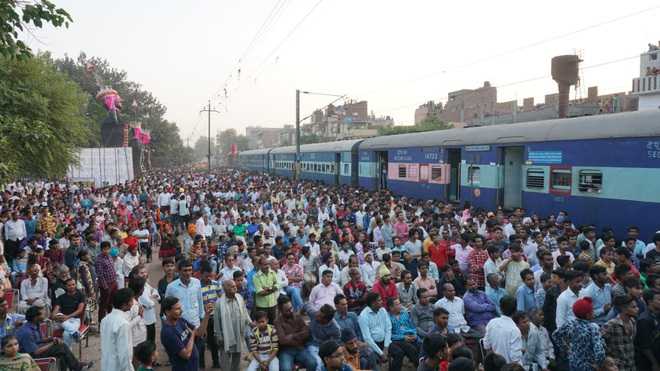
    Unmindful of danger, Dasehra celebrated on rly tracks
    Credit : Tribune
    • Yesterday, the Dussehra celebrations triggered panic among scores of residents at the Dasehra ground in Sector 46 of chandigarh when the effigy of Ravana suddenly “blasted”.“All three effigies went up in flames abruptly. Some onlookers, who were standing, were so petrified with the ‘blast-like sound’ that they fell down. Several children started crying. The exit gate was congested and posed problems for those rushing out of the venue.” A DSP was the chief guest at the venue. 
    • Also yesterday, Dussehra was celebrated at Dhuri railway crossing in Ludhiana (see above). People were seen roaming on the railway tracks to have a glimpse of the effigies unmindful of the lurking danger from speeding trains.
    • Flouting the orders of the high court, the heritage conservation committee of nagpur was pressured by a BJP Minister this year to give permission to hold dussehra celebrations inside a monument of national importance. platforms were put up right next to the heritage structure and most other conditions for giving the permission were also flouted. 
    • Early this year, a 1000 boys, aged 5-12 years, in a crammed room of a Kerala temple were subjected to smoke emanating from somewhere. Their parents had to get the polic to free them for a while so they could have a relief from the suffocating conditions. The children were part of a temple ritual which was to keep them away from their parents for a week. 
    • 22 people died, and 30 were injured during a stampede on a railway overbridge in Mumbai at dussehra time in 2017. 
    • Early in 2017, a fire broke out in Allahabad's Magh Mela. While no one died, all the belongings of the pilgrms got burnt. 
    • In 2015, at the Kumbh Mela in Nashik, selfies were banned on days that people took ritual baths in the Godavari river. Organisers say they conducted a study that showed people took too long taking selfies. This slows down the flow of people, leading to pushing and panic.
    • 33 people died when exiting from a dussehra celebration at Patna's gandhi maidan in 2014. The CM was the chief guest. A rumour that a live wire had fallen on the ground sparked a stampeded towards the only two exits that were open. The enquiry report of the incident mentioned that there were no lights at the exit gates or proper sound systems. There was no detailed crowd management plan for the event.
    • In 2013, Dussehra celebrations in Ratangarh in Datia District of Madhya Pradesh were marred by the deaths of 115 people and scores injured. The enquiry reports of a retired justice, CBI (only ordered by the High Court because of a public interest litigation), and the human rights commission are not to-date in the public domain. There is only a mention of the retired justice's report being tabled in the assembly more than a year later with one havaldar being found guilty ! Some officials were suspended after the incident. Among those officials, atleast the collector of Datia district was reinstated in his post as the MP Government never followed up with a chargesheet. 
    • There were only 10 policemen on duty to manage a crowd of pilgrims 1 lakh strong. Many press reports at the time recounted that police took bribes from tractor trolley operators to let them in into a no-traffic zone, in the midst of a single road choc-a-bloc with pilgrims headed over to a bridge over the Sindh river. When pilgrims protested, the police lathi-charged them, resulting in a crush. A rumour about the bridge they were on, collapsing, led to a stampede. 
    • There were press reports with names of people who said the police threw bodies as well as live people off the bridge into the Sindh river (or some jumped by themselives), to bring down the official count of the dead. The bodies from sindh river were never reported to be recovered from the river although some people, who were alive, made it out. That is why it was suspected that the actual count of dead people in the tragedy was far greater. 
    • There was no prior arrangement for primary medical aid and even drinking water, the Congress alleged, adding top district officials had not reached the spot even seven hours after the tragedy.
    • Earlier in 2013, 37 people died at Allahabad railway station on their way home from the Kumbh Mela. Officials said some 30 million visited the site that day, considered the most auspicious day to bathe in the river.There was a crush as thousands waited to board trains home. Delayed trains had led to massive overcrowding and the collapse of a footbridge. Up to 100 million pilgrims and Hindu ascetics were expected to attend the two-month long Kumbh Mela, the world’s largest religious festival. It is held every 12 years in a temporary city covering an area larger than Athens, spread over a wide sandy river bank in Allahabad.
    • More than 100 worshippers were killed in a stampede in January 2011 in Kerala, while 224 pilgrims died in September 2008 at a temple in Rajasthan. In 2008 also, 145 people died when a panicking crowd pushed people over a ravine near the Himalayan temple of Naina Devi.
    • 57 people had died at Ratangarh in Datia District in MP in 2006 in dussehra celebrations when they were swept away in the river's waters. The enquiry report of that tragedy too was never made public by the same government of shiv raj chouhan. Projected as Modi's rival to the PM post in the run up to the 2014 elections, he surely is Modi's equal in some respects atleast !
    • A fire swept through parts of the Shabri Kumbh Mela in Dangs, Gujarat, in early 2006, but was quickly brought under control by fire tenders stationed for the mela.  
    • There are many many other incidents I can see on the net even in the last few years. The point is, few public gatherings in our country which are of a religious nature, are organized with any sense of safety for and services to, the pilgrims.

    Improvements in Unmanned rail crossings in India..

    • To put what has happened in larger perspective, an RTI query from the Railway Board revealed that between 2014 and the end of March 2018, a total of 23,013 passengers were killed while trespassing railway tracks, alighting from running trains or falling off trains while standing close to the door.  
    • On the other hand, according to National Crime Record Bureau (NCRB) data, in 2015, 18,259 people died after falling from running train or in collision on railway tracks. So thousands of people are dying in our country each year through accidents on railway tracks. 
    • The Government has not always been a silent bystander - a government committee report in 2012 accused authorities of a "massacre" after a report revealed that approximately 15,000 people died every year trying to cross train tracks in India. The report said previous recommendations to make the world's fourth largest railway system safer had been ignored.
    • The report called on the government to urgently replace all railroad crossings with bridges or overpasses over the next five years. I am glad to say this is one area where the Government and the Railways have been working : On average, about 1250 unmanned level crossings have been eliminated each year starting 2012-13, till 2016-'17. Out of the roughly 29000 level crossings across India, 6000 or nearly 30% are still unmanned as of February 2018, but work to eliminate them is ongoing every year. The number of accidents on unmanned crossings has come down from 53 in 2012-13 to 20 in 2016-17.

    Why did the Amritsar train tragedy occur..

    We woke up to see horrid headlines of 61 people killed on amritsar train tracks and many injured as they wandered on to the rail tracks and were hit by a passing fast train. The event was not organised at that spot for the first time. Apaprently, the Ravana effigy was being burnt at the same place for quite some time. India Today said that :
    • Neither the organisers (of the Dussehra celebrations these people were watching), nor the police administration had barricaded the tracks to stop people from venturing onto them
    • Even though the exact number of police officials at the venue during the accident is not known, those present were busy providing security to the chief guest of the event Navjot Kaur Sidhu. Police officials and organisers ignored the security of the people.
    • The driver despite the presence of the crowd, neither sounded a siren nor reduced the speed of the train which was hurtling down at 100 kmph. Raliway authorities have said the driver could not see anything because of smoke and he was negotiating a curve (are these not reasons all the more go slow and sound horn of the train ?). However, the driver did inform the station master of the next station of the people hit by the train. 
    • There was no lighting around the tracks. The rescue operation after the accident was getting hampered as the authorities had not arranged any floodlights to search the bodies and injured who were thrown by the speeding trains. Video camera lights and mobile phones are being used to search for bodies.
    • A Tribune report quoted a local resident who said they have been requesting the authorities and their representatives in legislatures to talk with the railways and make sure trains are slowed down near this section of the track during Dussehra. “But no one has listened,” he lamented.

    Friday, October 19, 2018

    Energy from Renewables..

    The following are some of the highlights of what i have been reading lately on global warming :

    • In November 2016, the Arctic was already experiencing extraordinary anomalies. Temperatures were 20C above normal.
    • “The consequences of failing to keep the temperature below 1.5 C will be to wilfully condemn hundreds of millions of the poorest citizens of Earth to certain deaths from the severe impacts of climate change.”
    I started looking for some of the ways forward for countries to bring down Co2 emissions.. there are dozens of ways, and among them are :
    • Retrofitting existing buildings can save 70-90% of the energy used to heat and cool them. Such a move also tackles fuel poverty, creates local jobs and reduces deaths from cold. 
    • Switching transport from fossil fuels to electricity powered by renewables, cuts emissions but also removes the air pollution that is responsible for an epidemic of lethal respiratory disease. In Europe alone, about half a million people suffer premature deaths each year due to air pollution.
    • In 2015, Denmark generated 140 percent of its electricity requirements on one particularly windy day from wind turbines alone, the excess of which was exported to Germany, Norway and Sweden. In 2016, Germany came remarkably close to being completely run by clean energy for a day due to a surge in wind and solar power. 
    • But the Central American nation of Costa Rica beat all the European countries with its landmark achievement in green energy in 2016. For more than 250 days the country used zero fossil fuels and drew its electricity from hydropower plants, wind turbines and geothermal installations. Thanks to such efforts, the notion that renewables can run a whole country is no longer unfathomable. In fact, it is now an ideal to aspire to.
    • In November 2016, many, mostly low-income countries, from Bangladesh to Tanzania and Guatemala, committed to switching entirely to renewable energy by 2030-50 at the latest. China is installing more new wind energy capacity in a single year than the UK has in total.

    Thursday, October 18, 2018

    Denigrating the #MeToo Movement..

    A neighbour sent me a video, perhaps of his daughter (he did not say), saying things to camera denigrating the #MeToo movement. I wrote him back : 'Here are my observations on the video that you shared :

    1. I happened to be reading about slavery in america. the southern US states who wanted to retain slavery as their constitutional right, were as passionate about defending slavery, as this girl is that Indian women should not be voicing complaints against sexual exploitation.

    2. Perhaps this girl would do better to read more.. besides actresses, the accusers include large number of journalists complaining about the conduct of powerful editors. Recently former senior IAS officer Rupan Bajaj spoke up in support of the #MeToo movement. Rupan had similarly spoken about the chief of Punjab Police when the whole world like you, had problems with her speaking up. The court decided in her favour, but many years later, against many odds.

    3. I find the juxtaposition of the 'most women airline pilots in the world' with allegations of sexual exploitation (implying because we have the former we should not speak about the latter), ridiculous frankly. Just because we have the third highest no. of billionaires in the world, we should sweep our vast number of children suffering from serious malnutrition under the carpet (India has the highest no. of those as well) ?

    4. 'I dont know what is the truth' the lady says. Really ? has she grown up walking the streets of north india ? Has she heard and read the testimonies of these scores of women ? I am sure she is mature enough to know what her instincts are telling her.

    5. The fears about people being unable to feed themselves if slavery ended were also voiced, aplenty, by those who wanted to keep slavery on the constitution. So what this girl, and by extension, you, are saying is, if women want jobs they had better keep quiet about the utterly rampant sexual exploitation !

    6. Regarding misuse of protective laws by some women - all laws in our country are misused - some heavily so - including the criminal laws - by our own police forces. Should we stop filing cases of rape, dacoity and murders then ?

    7. Jessica Lal's murderer was set free by the justice system as his family manipulated it. But most people could see where the truth lay and the media rightly followed it up to force a re-trial. But in the cases of sexual exploitation, you would prefer the media should look the other way ? Why ?

    8. Again the girl should be reading more - an FIR was lodged by Tanushree and complaint made to the actor's association in 2008 immediately after the incident occurred. The politically connected accused made sure that her complaints were not followed up. Instead, Tanushree, her employees and her family were harrassed for an entire year. If the justice system delivered speedy justice ofcourse millions of cases would be filed by women as there are millions of sexual harrassment cases occuring.

    9. I am sure the girl means well, and so do you. Please try to see things from the point of view of women who suffer DAILY sexual harrassment on their way to work, at places of work, from their neighbours and even some distant family members. Read the news.

    Saturday, October 13, 2018

    The story of wheat...

    More of the earth’s surface is covered by wheat than by any other food crop. Wheat production is the third largest cereal production in the world, after maize and rice.

    In terms of dietary intake, however, wheat comes second to rice as a main food crop, given the more extensive use of maize as animal feed. Wheat is a hardy crop that can grow in a wide range of environmental conditions and that permits large-scale cultivation and long-term storage, making it key to the emergence of urban societies for millennia. Currently, about 65 percent of the wheat crop is used for food, 17 percent for animal feed, and 12 percent in industrial applications, including bio-fuels.

    Wheat is the largest deficit item in the developing country food basket. Between 1970 and 2010, more than half of the increment in wheat consumption was met by increased wheat imports, and several countries became totally dependent on imports for wheat.

    World hunger is rising year on year..

    I am distressed at reading Times of India and Hindustan Times reports on the recent UN report on climate change.. the articles do NOT communicate the urgency of the peril we are all in.

    During the second half of the twentieth century, global food availability and access developed rapidly enough to keep abreast of population growth. As a result, many countries improved their food security and made impressive achievements in reducing hunger and malnutrition.

    But now, World hunger is rising year on year - nearly a billion people suffered from chronic food deprivation in 2017, where a few years ago, these numbers were falling. Persistent instability in conflict-ridden regions, adverse climate events in many regions of the world and economic slowdowns that have affected more peaceful regions, all help to explain this deteriorating situation.

    In 2017, one in 7 people in South Asia was undernourished - a rate equalled or surpassed only by the Caribbean and many parts of Africa.

    The number of people facing crisis-level food insecurity (requiring immediate emergency action to safeguard their lives and preserve their livelihoods) continues to increase as well - from 80 million in 2015, to 124 million in 2017. Severe food insecurity is higher in 2017 than it was in 2014 in every major region, except North America and Europe.

    Anaemia is also growing in the world with grave consequences for brain development and physical output of those who are anaemic. Anaemia in pregnant women affects their to-be born children also, and life-long. In the years 2006-2016, India could reduce anaemia among women of reproductive age by only 4 percentage points, from 57 to 53 %. This tells us starkly about the lack of greens and nuts in the diet of women in our country.

    Climate variability and extremes are a key force behind the recent rise in global hunger. The number of extreme climate-related disasters, including extreme heat, droughts, floods and storms, has doubled since the early 1990s. These harm agricultural productivity, contributing to shortfalls in food availability, with knock-on effects causing food price hikes and income losses, that reduce people’s access to food.

    2011–2016 have been characterized by a number of severe droughts in many regions. Some of these feature among the most extreme droughts historically (e.g. state of California in the United States of America; Australia), while others were unusually prolonged and spread over larger areas (e.g. Somalia, Southern Africa, India, and the Dry Corridor of Central America).

    Exposure to more complex, frequent and intense climate extremes is threatening to erode and reverse gains made in ending hunger and malnutrition. The cumulative effect of changes in climate is undermining all dimensions of food security – food availability, access, utilization and stability.

    Severe droughts linked to the strong El Niño of 2015–2016 affected many countries, contributing to the recent uptick in undernourishment at the global level. In that period, there were below-normal rainfall levels over a large area of the globe. Information from country food balance sheets pointed to reductions in food availability and price increases.

    Changes in climate are already undermining production of major crops (wheat, rice and maize). Countries try to compensate for domestic production losses through imports, though supplies are often limited. Overall, more countries are vulnerable to the risk of food insecurity and malnutrition now, than they were in the early 1990s.

    Thursday, October 11, 2018

    India learnt lessons on disaster management..

    'October 12, 2013 saw a dramatic shift in the way India perceived and handled natural calamities, like Super Cyclone Phailin. Merely three months after devastating floods in Uttarakhand state left over 15,000 people dead, Indian government acted swiftly and decisively.

    Massive rescue operation ensured that every single soul, in direct line of the storm, was evacuated safely or forcefully. As Indian Meteorological Department issued a timely warning, Odisha government set a target of 'zero casualty'.

    Cyclone Phailin was nearly the size of hurricane Katrina, which killed 1,200 people in 2005 and caused devastating flooding in New Orleans. It also had the wind power of 1992's hurricane Andrew, which packed 265 kph winds at landfall.

    The Collectors of all seven districts like Ganjam, Gajapati, Puri, Jagatsingpur, Kendrapara, Nayagarh and Khurda were directed to start evacuation and ensure 100 per cent evacuation of people to cyclone and flood shelters and other safe places in a single day. Till the time Phailin made landfall, around 10,00,000 people had been evacuated from various districts and villages of Odisha and Andhra Pradesh.

    Teams were constituted and made ready with relief and rehabilitation material. Road clearing teams were instructed to clear roads within 12 hours of the cyclone striking. Police forces were deployed in heavy numbers to ensure quick and safe passage of relief material to the affected areas. Food packets for one lakh people were arranged that could be air dropped to the most severely affected areas. Several teams of Indian Army and Navy were on the standby across the region to begin massive relief and rescue operation. 

    A crucial role was played by National Disaster Relief Force - formulated under National Disaster Management Act (NDMA) of 2005. The force is gradually emerging as the most visible and vibrant multi-disciplinary, multi-skilled, high-tech force of the NDMA capable of dealing with all types of natural and man-made disasters. It appeared India had learnt its lessons well.

    Block Development Officers were instructed to check all the multipurpose cyclone shelters that had been constructed, for readiness with all equipment like generators, power saws, tower lights, megaphones and utensils. Steps were taken to keep the communication systems operational. Satellite phones were issued to the District Collectors. Identification of additional schools, colleges and other public buildings that could be used as cyclone shelters and all arrangements for electricity, drinking water and temporary toilets were made. Assistance from defence forces and helicopters for rescue operation and airdropping of food packets was requested. Boats for rescue and relief operation, vehicles for evacuation and transportation of relief materials were kept in readiness. Pre-positioning of sufficient stock of fuel for vehicles was ensured.

    The World Bank, appreciating the effort of the state government said that, “Successfully evacuating a million people is not a small task. This cannot be merely achieved by kicking the entire state machinery into top gear for three to four days following a cyclone warning. This has taken years of planning, construction of disaster risk mitigation infrastructure, setting up of evacuation protocols, identification of potential safe buildings and most importantly, working with communities and local organizations in setting up volunteer teams who knew exactly what needed to be done.”

    The super cyclone that had struck Orissa back in 1999..

    As I anxiously looked up news of cyclone Titli across Orissa and Andhra Pradesh (AP) (eight people dead in AP so far), I happened to read of the super cylcone that had struck Orissa back in 1999. The 16–20 ft surge brought water up to 35 km inland, carrying along with it coastal debris and inundating towns and villages. 1.6 MILLION homes were damaged. Estimates of the people dead ranged from 10,000 to 30,000. The storm surge killed the most people followed by torrential rain. 2.5 million people were marooned and nearly half a million livestock casualties were reported. In total, 13 million people were affected by the storm. 

    Stations in Paradip and Bhubaneswar each recorded sustained winds of 150 km/h before their instruments failed. The strong winds damaged electric lines and uprooted trees over 50 years old in Puri and Kendrapada. Downed power lines across the state cut off communications between Odisha and the rest of the world for over 24 hours and caused widespread power outagesDue to severe damage to air traffic control infrastructure, the Biju Patnaik International Airport was closed until 2 November, curtailing relief operations.

    Twelve districts of Odisha suffered severe damage, reporting complete breakdown of essential services. Over 70% of homes were destroyed across the seven worst affected districts. Some 11,000 schools were significantly damaged or destroyed. All major district roads in the area were either washed out or blocked by felled trees. In Bhubaneswar, 60% of trees were flattened by the winds and rain. aerial surveys revealed that the entire city was submerged by floodwaters. Thousands of people suffered chemical burns after the flooding mixed industrial chemicals into bathing ponds.

    The destruction wrought by the cyclone was expected to cause a six-month-long total loss of normal livelihood. The Odisha Government made appeals to various non-governmental organizations as the government's relief supplies only covered 40% of affected areas. 

    Tuesday, October 09, 2018

    Accelerating to a 1.5 degrees C warmer world by 2030 - 2

    Co2 concentrations in the air had begun to be measured in 1958. It stood at 316 parts per million then, but had touched 400 parts per million by 2016. 

    Natural sources of CO2, from forest fires to soil and plant respiration and decomposition, are much bigger — about 30 times larger than what mankind produces each year. But natural sinks, like plant growth and the oceans, tend to soak that up. The excess produced by mankind’s thirst for energy is what makes the CO2 concentration in the air go up and up. Once in the air, that gas can stay there for millennia.

    As atmospheric carbon dioxide concentrations increase, there will be near-term or “transient” warming (range of projected temperatures in blue) which is only about half as large as the total or “equilibrium” warming (range of projected temperatures in red) that will eventually occur if concentrations are stabilized at those values.


    That implies that the current level of concentration of CO2 in the atmosphere of 400 + parts per million, which caused 1 degrees C warming in its transient phase, will end up causing 2.5 C warming as it stabilizes in the atmosphere.

    The graphs on the right show how changes in greenhouse gas emissions (top panel) are related to changes in atmospheric concentrations (bottom panel). It would take an 80% reduction in greenhouse gas emissions (green line in top panel) to stabilize atmospheric concentrations (green line, bottom panel).

    That implies to me that if today we miraculously cut down our emissions by 80 %, THEN our atmospheric concentrations would stabilize at the current level, resulting in a final temperature rise of 2.5 degrees C. 

    My husband asked that given current projections, when are we expected to raise the earth's overall surface temperature further, and by how much. The graph below gives the current projections. By 2030, we may be warmer by 2 degrees C overall, as the latent equilibrium warming described above may add to the 1.5 degrees C we are expected to hit anyway. 


    By 2040, we may be hitting 2.5 degrees C, combining the 2 degrees C with latent warming. And by 2050, 3 degrees C temperature rise, overall. Current trends are on track to raise temperatures, overall, by 5.5 degrees C by 2100 if drastic measures are not taken immediately. 

    Based on current understanding, the warming levels we are gaining are expected to be nearly irreversible for more than 1,000 years.

    Monday, October 08, 2018

    Accelerating to a 1.5 degrees C warmer world by 2030..

    My husband sent me a link which said that the UN has announced that the earth is on track to get 1.5 degrees C warmer by 2030.. To me that implies that it would be 2 or 2.5 degrees C warmer by 2050. The impacts of even this much rise will be overwhelming and will disrupt life support systems as we know them now.

    Observations indicate a tenfold increase in the surface area of the planet experiencing extreme heat since the 1950s. This scenario could lead to a 4 degrees C rise by the end of the century.. That means, the children being born today and hereafter would live to see this : a world of unprecedented heat waves, severe drought, and major floods in many regions. Some regions of the globe, such as parts of the Middle East and the American West, may become inhabitable to humans because of extreme temperatures.

    Increasing aridity and drought are likely to increase substantially in many developing countries located in the tropics. The oceans provide people with about 20 percent of their dietary protein. However, ocean acidification caused by climate change is disrupting the food web. On land, an increase of 2 degrees C would almost double the water deficit and would lead to a drop in wheat and maize harvests. If temperatures get too hot when these plants are flowering, their growth can become stunted, leading to decreased or no edible food crop.

    We are accelerating towards a 4 degrees C warmer world much before the end of this century. If we do no more than we are doing today to reduce GHG emissions, the IPCC projects that temperature in 2100 will be up to approximately five degrees higher than it is today.

    The impacts of the extreme heat waves projected for a 4°C world have not been evaluated, but they could be expected to vastly exceed the consequences experienced to date (heat-related deaths, forest fires, harvest losses) and potentially exceed the adaptive capacities of many societies and natural systems.

    A 4°C world is likely to be one in which communities, cities and countries would experience severe disruptions, damage, and dislocation, with many of these risks spread unequally. It is likely that the poor will suffer most and the global community could become more fractured, and unequal than today.

    When the global mean temperatures have risen 4 degrees C over pre-industrial levels, the largest warming will occur over land and range from 4°C to 10°C. Increases of 6°C or more in average monthly summer temperatures would be expected in large regions of the world. Almost all summer months are likely to be warmer than the most extreme heat waves presently experienced. For example, the warmest July in the Mediterranean region could be 9°C warmer than today’s warmest July.

    In this new high-temperature climate regime, the coolest months are likely to be substantially warmer than the warmest months at the end of the 20th century.

      Sunday, October 07, 2018

      Chinese Dictatorship.. Is India Far Behind ?

      I am actually quite a dodo at keeping up with news.. I bury my head in the sand, emerging when something bothers me, to read in depth on the matter. I was surprised when Dad told me recently that Xi Ping had gotten the Chinese party congress to declare him president for life ! I thought that was dangerous not only to china but to the rest of the world as well – what if we had a mad man in charge and unable to shake him off ? China today domiantes world affairs, much as the US does. We already have out of control Trump in the US, but alteast can look forward to him being deposed either before, or at the time of the next US election.

      Concurrently, Hongkong is fearing being completely assimilated in the mainland China political system whereas it is said it was promised autonomy at the time of reverting back to china.

      A documentary by Australian TV says China is experimenting with a social credit monitoring system much like the financial credit monitoring system to assess every individual in society on how much they comply with laws. Those with bad social credit will be denied use of long distance travel and so on. Its scary.

      The system has been used to already block nine million people with "low scores" from purchasing domestic flights. While still in the preliminary stages, the system has been used to ban people and their children from certain schools, prevent low scorers from renting hotels, using credit cards, and blacklist individuals from being able to procure employment.[Criticism of this program has been widespread with the proposed system being described by Human Rights Watch as "chilling" and filled with arbitrary abuses.

      However, survey results in China show that wealthier, higher educated, urban respondents perceive social credit systems as an instrument to close institutional and regulatory gaps, leading to more honest and law-abiding behavior in society, and less as an instrument of surveillance. 

      But a Queensland University of Technology researcher has said that while the social credit system can be used to punish political dissenters, it may have positive benefits for Chinese citizens because government officials can be blacklisted for corrupt behaviour. Over 1,100 officials were on restricted lists at December 2017, according to the state media organisation People’s Daily.

      But India is following in China's wake ofcourse.. 'Advanced Application for Social Media Analytics' or AASMA – was developed by the Indraprastha Institute of Information Technology, Delhi, with funding from the Union Ministry of Electronics and Information Technology around 2013-2014. Since then, its use by government agencies has grown manifold without much public scrutiny. More than 40 state and Central government departments had deployed the tool by April 2017 and another 75 had requested its installation at the time.

      The tool can “24X7” collect and analyse “live data” on users from “multiple social networks” including Twitter, Facebook, YouTube, Flickr, and Google+. It can track social media profiles, their posts and networks of connections to identify “top users”, and conduct “sentiment analysis” of their posts to categorise them as either “positive” or “negative”.

      “The biggest concern around use of this tool is there is no transparency,” said Amber Sinha of the Centre for Internet and Society, a non-profit research organisation. Sinha added, “We don’t know who is using it for what purpose. We don’t know whether the government agencies are just using it to aggregate data of social media chatter or tracking profiles of past criminals or profiling each individual. If they are tracking social media activities of each individual, it would have a chilling effect on free speech.”

      Do we want to encourage foreign students to study in India ?

      Some 5 lakh indians study abroad every year and less than 10 % of that number come from other countries to study in india. For years, Congress had been trying to open up India’s higher education sector to foreign universities. But the bill could not be passed as it was strongly opposed by BJP. Once in power itself, BJP did a turnaround – as it did on most other things, and has been trying to invite foreign universtities to india, without great success. That is not to say there are no arguments against inviting foreign universities to india, but thats another discussion.

      But the story in this piece is along another track.. Failing in the above, the government early this year, launched a scheme to offer scholarship to half the foreign students who want to study in india, in the hope of quadrupling their numbers by 2023. Currently, one quarter of foreign students in India are from Nepal, and 10 % from Afghanistan. The scheme is to be marketed to 30 countries in South and West Asia, Africa and Eastern Europe.

      But the continuous wave of violence and communal / caste disturbances invoked by the Hindu right in universities are surely counter productive to this endeavour. The latest is Sharda University in Greater Noida where a week ago, a minor incident grew into a brawl between Afghan and local students. Then Gau rakshak samiti and Bajrangdal members came in subsequently and made infllammatory speeches that resulted in a bigger riot the day before. Ayan, a 21-year-old Afghan student, said he had been getting calls from unknown numbers. “We hear things like ‘Afghanistan murdabad’ and ‘Pakistanis are pigs’,” he said. “We consider India our second home but we feel unsafe here.” 

      A Kashmiri student said : "Now most of us don’t get out for our Friday namaz. We know elections are coming, so people will do anything to get more followers.Thankfully, the District Magistrate of Greater Noida has taken some strong steps. But once again the Hindu right has shown that they are the ugliest face of india.

      Thursday, October 04, 2018

      Love for One's Mother - 2

      A cousin remarked : Boy from yesterday has no excuse...we're about today when people have the exposure.

      I answered : Actually he is a sweet boy still, but perhaps no one has shared with him that alternative ways of family life are possible and productive. That is why, films and TV have a great role to play.

      The cousin asked : Who are the worst (in regard to treatment of women) ? Bihari, UP or Haryana ? I know it's a general question but trying to understand the traits.

      I responded : I feel Haryana is awful in this respect even though individual women have great guts like the wrestler women, or like kangana's character datto. But men generally look at women as part of their property.

      UP and Bihar have ofcourse millenia of culture behind them - North Indian civilization grew up around the rivers that dominate north india. the culture is very sweet, accommodating, family oriented. But women are property all the same and must do most of the really difficult tasks in farming and managing housework.

      That is not to say men dont bear far more burden than women in some of the most dangerous occupations of the world - the army, mining, and many more. But still, the balance is skewed against women overwhelmingly.

      It is parents' excessive focus on sons as carriers of family legacy, genes, family future and as support in their older years, that is the culprit. It is mothers' failing equally as fathers, who continue to raise their sons in a skewed fashion - exactly as maid bimla has been doing with her boy.

      The love for one's Mother..

      Today I saw a good example of what love for the mother means in many parts of North India today.. My conclusion – women have no agency in many North Indian men’s eyes, except to serve men in various ways - mothers no exception.

      A maid had come to fetch some thick tree branches that had fallen down in our garden in yesterday’s wind gust. Our helpers had spent all morning chopping and laying them together neatly to be taken by anyone they would be useful to.

      The maid came with her 6 foot (though thinnish) boy who was driving an auto in which the wood from our garden was to be carried. While I was figuring out with other workmen whether they had satisfactorily completed another delicate job at our place, I could see her staggering out with head-loads of wood of great weight. In-between I called out to her boy who sat twiddling his thumbs in a chair outside, to come and help his mother. He did not. His mother called out to her boy repeatedly to help too, to no effect.

      This went for some 30 minutes and the wood had still not all been taken out (the way out of our garden is a bit convoluted anyway). Free of the workmen, I at last asked the boy why he refused to help his mother for a job important for the family (I think the wood would be worth a few hundred rupees). He said yeh aurton ka kaam hai. I told him I did not know why his mother bothered cooking for him and feeding him. He smirked. I also told him I found him stupid. But his mother just laughed and the boy did not seem to mind at all ! So off he went trailing his mother in shiny jeans as she staggered towards the auto with the last head-load of wood. 

      You see this all the time – women stagger carrying drums of water in North Indian village lanes, while men who say they cant find work, lounge around. In uttarakhand all back breaking farming tasks seem to be done by women only.

      Yeh kaun si sanskriti hai jis par paens gaye ja rahe hain by the right wingers ? kya sanskriti sirf hazaron saal purane ideals hote hain aur uske bad jo kuch yatharth main hai, weh sanskriti nahin hai ? mujhe to lagta hai, yahi hamari north indian sanskriti hai – aurton ka istemal, unhein torna marorana, and cheap aspirations of the men - sex, money and power – nothing idealistic there.

      Usi power hunger main majoritarianism mix kar deejiye and it satisfies their need for more power over others. At its heart, the hindu right does not seem to be about india at all. It is about a toxic mishmash of ideas that make puny people feel powerful over others.

      Saturday, September 29, 2018

      Factoids..

      In 1951, at the time of the first population Census, just 18% of Indians were literate while life expectancy was 32 years. By 2014 in over 60 years, life expectancy had more than doubled to 68. Literacy had grown even faster to reach 72 % by 2015.

      A chunk of the country’s 1.2 billion people are still chronically malnourished, many are unemployed. At least 32% of India’s population live below the international poverty line -- spending less than US$1.2 a day -- while about 68% of the population live on less than US$2 a day, a World Bank report said in 2010.

      More than a third of Indians aged 15 to 49 are undernourished, according to India’s National Family Health Survey in 2006.

      A 2011 Wall Street Journal investigation into India’s government-run healthcare system described public hospitals as “out of date, short-staffed and filthy.”
      “Lack of government spending is largely to blame for our ailing healthcare system,” said Pramod Paliwal, the secretary of the Jaipur-based Indian Institute of Rural Development, a non-profit focusing on rural healthcare. India invests only 1% of its gross domestic product in health care, according to the Paris-based Organization for Economic Cooperation and Development. India’s healthcare expenditure, the OECD found, was one of the lowest in the world. 
      A 2013 study by New Delhi-based non-profit Pratham, which surveyed schoolchildren across 500 districts, found that a fifth of 10-year-olds could not read sentences. Around 50% of seven-year-olds surveyed couldn’t read letters and more than 50% of 14-year-olds were unable to divide numbers, the study found. A similar study on higher education last year estimated that fewer than 10% of graduates with masters degrees in business administration, were employable.
      The United Nations Development Program’s Human Development Report ranked India 132 out of 187 countries on its gender inequality index in 2013. All countries in South Asia, with the exception of Afghanistan, the report said, were a better place for women than India. 

      A memebr of the Gurudwara Prabhandak Committee of Delhi said in a TV programme that gurudwaras across the country must be feeding about a crore of indians daily, free of charge. 

      Friday, September 28, 2018

      Does BJP really care for abandoned women ?

      A relative asked me : ‘What is happening on triple talaq? Why all parties are keeping quiet except BJP ?’

      I wrote back to him : I read the supreme court judgement delivered in 2017. It said that triple talaq was in contravention of an earlier law and an earlier judgement so was set aside until the legislature made an appropriate law. Then I saw Asaddudin Owaissi’s views on the ordinance promulgated by the Government.

      I find him right on this, as in most other observation he makes. He says that when adultery and gay relationships have been decriminalized in india, it is silly of the central govt. to make a law send to jail a man because he pronounced the words talaq 3 times ! Simply making it ineffectual – that is, it no longer dissolves a marriage, is enough. Which is as much what the court said in its judgement. He says there are millions of women in our country, muslim and otherwise, who have been abandoned and lack sufficient societal support. He would welcome a fund for the support of all such women if the central government really wanted to express compassion towards them.

      It is obvious the BJP set out not to help abandoned muslim women, but to make it a faltu talking point which is how someone like you becomes concerned about it ! in a country where millions of indians are without water, without food, it is criminal of a political party to waste all our time like this. But ofcourse bettering our lot isnt BJP’s focus. WHATEVER subject you pick, once you investigate below their glib talk, this is what you find.

      Please don’t be misled by the noise made by the hindu right on the name of Owaissi. Yes his brother Akbaruddin said some rash things a few years ago when highly provoked by the hindu right. But Asaddudin is one of our finest politicians where public speaking and thoughts on how to solve our problems is concerned. I have heard many of his speeches in and out of parliament. They are all on youtube. You can listen to him on other subjects yourself if you like. I havent tracked his administrative skills yet though.

      While on the point of demonisation, have you seen bal thackeray or the many heads of the hydra headed sangh pariwar, similarly demonised ? they say totally unacceptable things about india and indians, day in and day out, 365 days a year, but BJP feels comfortable with all this objectionable talk !

      Fomenting hatred in Uttar Pradesh..

      From a May 2018 article : ‘The Muzaffarnagar riots in September 2013 changed everything. Village Lisad, where Hindus and Muslims had lived peacefully for generations, witnessed the deadliest violence. Thirteen Muslim men were killed in Lisad, and with the exception of one elderly man named Basheer, who refused to leave the home where he was born, the entire minority community fled and never returned. At least 60 people, mostly Muslims, were killed in the religious violence. An estimated 60,000 Muslims were displaced.’

      This was part of Modi and Shah’s winning strategy for the 2014 elections and widely seen as such at the time the violence took place. We have not seen the BJP or RSS cry about the 60,000 muslims displaced in western UP for five years, have we ?

      An article at the the time of Kairana by election in UP in May this year : ‘The issue of pending criminal cases against the Jats has also divided the community over the RLD and the BJP. Those who are only concerned about the sugarcane crisis have been inclined to vote against the BJP, while those who have to worry about criminal cases believe it safer to vote for the BJP. The BJP had vowed to withdraw all "false" cases related to the riots if voted to power, and the Adityanath government has been making good on its promise.’

      This reveals BJP’s ‘governance’ strategy employed I think by the Nazis also : 1. Precipitate a divide between society and incite hatred in the majority, for the minority. 2. Get them to participate widely in murder and mayhem against the minority. 3. Wed them to you for decades to come by the threat of ‘opening criminal cases’ for that period of mayhem !

      ++++++++++++++++++++++++

      There is a poignancy in the reflections below on the Muzaffarnagar riots in September 2013 – and a harsh reality on why victims of violence from neighbours are often unable to come back to their homes, ever.

      Malik and Singh talked at length about how much they regretted the flight of the Muslims from their village. It has cost the Jats both economically and psychologically.

      The absent Muslims, who filled the roles of carpenters, farmhands, manual labourers, electricians, ironsmiths and welders, are sorely missed by the Jats, who now end up paying double for getting the same services from outside the village.

      There are many Jats who remain convinced that their village had been cursed after the bloodshed. They talk about the animals that started dying, especially calves, a few months after the Muslims left. Those who have family members charged for rioting, murder and attempt to murder, have been living in a constant state of fear for their loved ones.

      "A few hours of violence has cost us so much. The village had changed forever," Malik said, adding that he did not participate in the violence, "It makes me sad to see the empty houses."
      Singh said, "It never should have happened."

      But when the village was debating whether to bring back the Muslims, Mallik was against it.
      "It's too late. It would have been too complicated, too messy, and too dangerous," he said. "Remember, there are still people with cases against them."’

      +++++++++++++++++

      At last – in Black and White – how BJP is tearing the fabric of our country, mohalla by mohalla, just so it can be in power.. from an article analysing the recent UP bypoll win for the opposition :  'Yet, none of these factors are as important as a large section of Kairana’s voters uniting to counter the phenomenon of everyday communalism, a term which academicians Sudha Pai and Sajjan Kumar have coined to explain the ease with which the BJP turns every election into a Hindu-Muslim contest and wins. Kairana has, however, shown Jats and Muslims — despite being pitted against each other after the 2013 Muzaffarnagar riots — sinking their differences to overcome the severe socio-economic implications that everyday communalism spawns.

      This phenomenon involves, write Pai and Kumar in Everyday Communalism: Riots in Contemporary Uttar Pradesh, recruitment of local leaders for "using small, mundane but provocative local incidents to gradually create animosity and social jealousies between Hindus and Muslims who have lived together for a long time".'

      The article continues : 'These issues could be as insignificant as a road accident, a game of cricket, a drainage pipe of one house leaking into the premises of another. The aim behind framing every minor issue as a Hindu-Muslim problem is to “create a permanent anti-Muslim social prejudice and make it acceptable in the popular discourse,” argue Pai and Kumar.

      Before the grisly riots rocked the Muzaffarnagar-Shamli belt in August-September 2013, a clutch of petty issues was ingeniously turned to pit Hindus against Muslims. Take what happened in March 2013 in Buchakheri village, Kairana, which falls in Shamli district. There the wood stored for the Holi bonfire was set ablaze by no one knows who. Blaming the Muslims for it, Buchakheri’s Gujjars attacked a mosque, prompting police to open fire. Then BJP MLAs Hukum Singh and Suresh Rana descended on the village and linked the firing to Shamli then having a Muslim superintendent of police. A minor issue was given a communal turn and then escalated to become an election campaign issue.'

      I dont know if you feel like vomiting on reading this.. but I do. We are witnessing the ongoing destruction of the idea of India.. no matter how much 'development' we do. Perhaps it was always so, even under the congress... what is critical to remember is that this discourse is NOT about muslims - but about creating an 'Other' from which a political party claims to protect you from. as the muslim card stops working, the BJP will need to create many 'Other' groups for you to hate, as that is the only politics it thinks, works. Gradually their polemic will descend into the North Indians against South Indians, Outsiders against Marathas etc., cards which have already been played regionally at different times.